
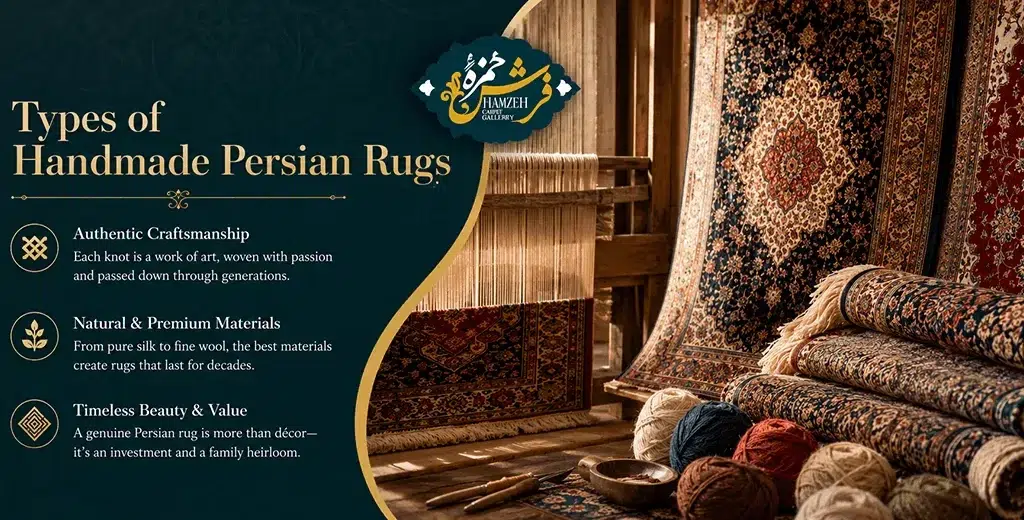
When you step onto a hand-knotted Persian rug, you are stepping onto a living piece of history. Every knot represents months—sometimes years—of meticulous craftsmanship by artisans who pass down their techniques through generations. In a world dominated by mass-produced decor, authentic types of handmade Persian rugs bring warmth, soul, and timeless elegance to any room.
However, navigating the world of Persian rugs can feel overwhelming. Terms like “pure silk,” “knot density,” “medallion layout,” and “tribal weave” leave many buyers unsure of where to begin. Understanding the different varieties is not just about aesthetics—it is essential for protecting your money. Unlike machine-made alternatives, a genuine handmade Persian rug retains its value and often appreciates over time as a prized heirloom.
This comprehensive guide breaks down everything you need to know about types of handmade Persian rugs, from raw materials and regional styles to evaluation techniques and purchasing tips.
Types of Handmade Persian Rugs by Fiber and Material
The choice of raw materials forms the foundation of any rug. The fibers used for the pile (the soft top layer), warp (vertical structural threads), and weft (horizontal structural threads) determine a rug’s durability, feel, weight, and price.
| Fiber Type | Fineness & Sheen | Foot-Traffic Durability | Best Suited For |
| Pure Silk | Extremely Fine & Lustrous | Moderate (Decorative) | Formal parlors, wall hangings, low-traffic areas |
| Silk & Wool Blend | Fine with Subtle Sheen | High | Living rooms, formal dining areas |
| Pure Wool | Medium & Soft | Exceptional | High-traffic family rooms, hallways |
Pure Silk, Silk-Inlaid, and Silk-Base Rugs
Silk is the most luxurious material used in rug making. Natural silk fibers allow weavers to tie exceptionally small knots, creating breathtaking detail and vivid colors.
- Pure Silk: In a silk handmade Persian rug, the pile, warp, and weft are all made of pure silk. These rugs are ultra-thin, lightweight, and shift in sheen depending on the viewing angle. They are primarily used as decorative masterpieces, formal accents, or wall tapestries.
- Silk-Inlaid (Gol- برجسته / Silk Highlighted): The main background is woven from fine wool, while intricate accents—such as flowers or borders—are woven in silk. This technique creates a striking three-dimensional visual depth.
- Silk-Base: The structural foundation (warp and weft) consists of silk, allowing for extreme knot density, while the pile itself may combine wool or fine kurk.
Wool and Wool-Base Persian Rugs
Wool is the traditional and most practical fiber in Persian weaving. High-grade sheep’s wool is naturally springy, stain-resistant, and comfortable underfoot.
- Pure Wool: The pile, warp, and weft are constructed entirely from natural wool. These rugs feature thicker piles, rich texture, and outstanding durability for daily living.
- Wool-Base: The structural warp and weft are wool, while the pile incorporates wool and silk highlights. This approach is common in village and tribal creations.
Kurk Wool and Cotton Foundation Rugs
- Kurk Wool: Kurk refers to the fine, velvety fleece combed from the underbelly of sheep. Rugs crafted with kurk wool offer a softness close to silk while retaining the rugged resilience of wool. Cities like Isfahan and Nain are famous for using kurk.
- Cotton Foundation: Cotton is the most stable material for a rug’s internal skeleton. Because cotton does not stretch or warp easily, it ensures the finished rug lays perfectly flat on the floor.
Classic Persian Rug Patterns and Designs
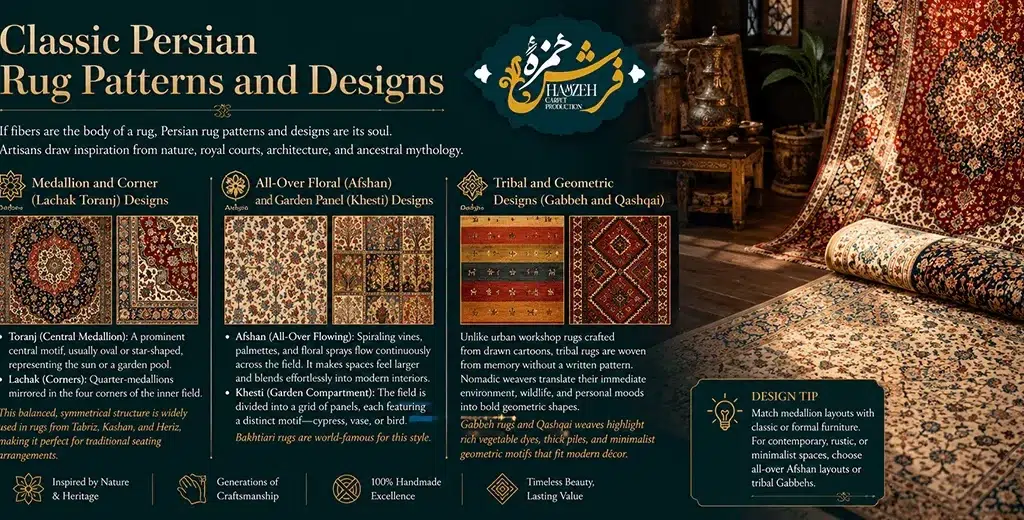
If fibers are the body of a rug, Persian rug patterns and designs are its soul. Artisans draw inspiration from nature, royal courts, architecture, and ancestral mythology.
Medallion and Corner (Lachak Toranj) Designs
This is the quintessential Persian rug layout:
- Toranj (Central Medallion): A prominent central motif, usually oval or star-shaped, representing the sun or a garden pool.
- Lachak (Corners): Quarter-medallions mirrored in the four corners of the inner field.
This balanced, symmetrical structure is widely used in rugs from Tabriz, Kashan, and Heriz, making it perfect for traditional seating arrangements.
All-Over Floral (Afshan) and Garden Panel (Khesti) Designs
- Afshan (All-Over Flowing): This design eliminates the central medallion entirely. Spiraling vines, palmettes, and floral sprays flow continuously across the field. Because it lacks a single focal point, an Afshan rug makes spaces feel larger and blends effortlessly into modern interiors.
- Khesti (Garden Compartment): The field is divided into a grid of squares or rectangles. Each panel features a distinct motif—a cypress tree, a flower vase, or a bird. Bakhtiari rugs are world-famous for this style.
Tribal and Geometric Designs (Gabbeh and Qashqai)
Unlike urban workshop rugs crafted from drawn cartoons, tribal rugs are woven from memory without a written pattern. Nomadic weavers translate their immediate environment, wildlife, and personal moods into bold geometric shapes. Gabbeh rugs and Qashqai weaves highlight rich vegetable dyes, thick piles, and minimalist geometric motifs that fit modern decor.
Design Tip: Match medallion layouts with classic or formal furniture. For contemporary, rustic, or minimalist spaces, choose all-over Afshan layouts or tribal Gabbehs.
Types of Handmade Persian Rugs by Origin and Weaving City
Geographic origin defines a rug’s personality. Each major weaving city uses distinct knot techniques (Turkish symmetric vs. Persian asymmetric), color palettes, and structural standards.
Tabriz Rugs: Precision and High Knot Density
Tabriz is a global capital of rug weaving, celebrated for technical precision and artistic versatility.
- Key Characteristics: Woven with the symmetric Turkish knot using a metal hook, resulting in exceptionally straight lines and crisp detail.
- Knot Density: High to extremely high (often 50 to 90+ Raj / ~350 to 800+ KPSI).
- Common Patterns: Mahi (Fish pattern), Tabriz medallion, real-life scenes, and allegorical trees.
Isfahan and Nain Rugs: Classical Elegance and Soft Palettes
Rugs from Isfahan and Nain are synonymous with royalty, fine craftsmanship, and soft, soothing colors.
- Isfahan: Built on silk warps with ultra-fine kurk wool piles. They feature intricate arabesques, spiraling vines, and majestic jewel tones (indigo, ruby red, and turquoise).
- Nain: Classified by “La” (layer count of warp threads: 4La, 6La, 9La—where lower numbers signify finer quality). Known for neutral backgrounds in ivory, cream, and navy blue.
Qom, Kashan, and Kerman Rugs
- Qom: The modern capital of pure silk rugs. Qom rugs feature extraordinarily fine knot density, vibrant colorways, and innovative motifs. They are prime targets for collectors.
- Kashan: Famous for classic Shah Abbasi floral motifs, deep crimson backgrounds, and navy borders. They offer exceptional longevity under heavy use.
- Kerman: Celebrated for high-grade wool and natural vegetable dyes. Kerman rugs are famous for aging gracefully—gaining a softer patina over decades.
Persian Rug Types by Size and Dimensions
Handmade Persian rugs follow traditional size classifications:
| Traditional Name | Approx. Dimensions | Ideal Placement |
| Kalagi / Large Room | 9×12 ft, 10×14 ft, or larger | Large living rooms, formal dining areas |
| Pardah / Medium | ~5×8 ft to 6×9 ft | Bedrooms, medium seating zones |
| Zaronim / Accent | ~3.5×5 ft | Foyers, small nooks, entryway accents |
| Kenareh / Runner | 2.5–3.5 ft wide x 8–20 ft long | Hallways, staircases, galley kitchens |
| Poshti / Hearth | ~2×3 ft to 2×4 ft | Accent mats, wall hangings |
Key Factors Influencing Handmade Persian Rug Prices
Understanding pricing requires looking beyond overall size. A smaller silk rug can cost significantly more than a large wool rug due to these core factors:
- Knot Density (KPSI / Raj): A higher Persian rug knot density guide rating means more knots per square inch, requiring months of additional labor.
- Material Quality: Pure natural silk commands the highest prices, followed by kurk wool blends, and standard mountain wool.
- Dye Source: Natural plant-based dyes (madder root, walnut husks, indigo) command a premium over synthetic aniline dyes due to their rich aging characteristics.
- Condition and Age: Antique rugs in original condition carry collector value. Discoloration, heavy restoration, or warped edges lower the market value.
Persian Rug Buying Guide: How to Spot Authenticity
Learning how to tell an authentic Persian rug apart from a machine-made copy requires inspecting a few physical details:
- Inspect the Backing: Flip the rug over. A genuine hand-knotted rug shows an exact mirror image of the front pattern on the back, complete with slight human variations in knot size. Machine-made rugs use synthetic backings or plastic-coated threads.
- Examine the Fringes: On an authentic rug, the fringes are the actual extended threads of the warp (the foundation). On machine-made rugs, fringes are sewn or glued onto the edges afterward.
- Perform a Colorfast Test: Rub a damp white cloth firmly over a small section of the pile. If dye transfers to the cloth, low-quality synthetic dyes were used, which may bleed during washing.
- Check for Flexibility: Hand-knotted rugs roll easily in both directions. Machine-made rugs have stiff backings that resist cross-rolling.
Frequently Asked Questions About Handmade Persian Rugs (FAQ)
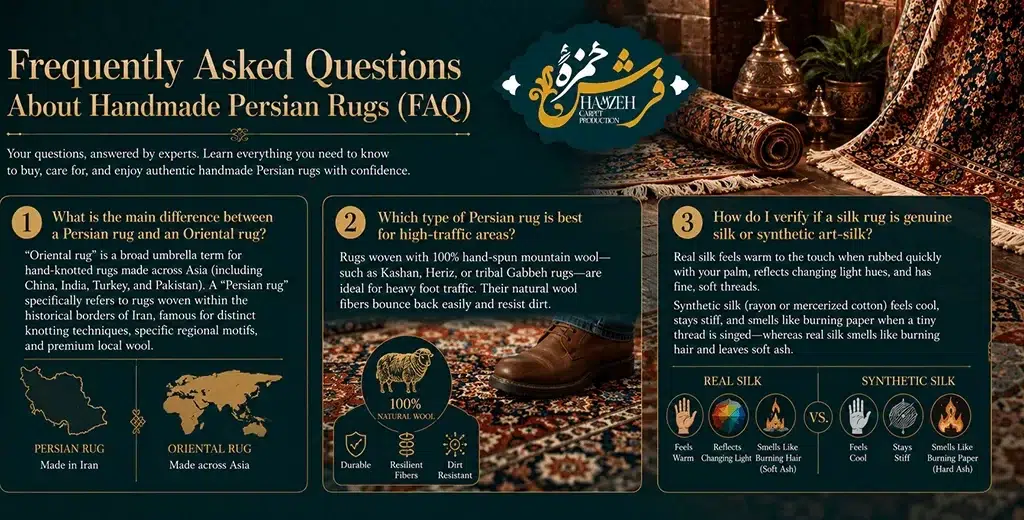
1. What is the main difference between a Persian rug and an Oriental rug?
“Oriental rug” is a broad umbrella term for hand-knotted rugs made across Asia (including China, India, Turkey, and Pakistan). A “Persian rug” specifically refers to rugs woven within the historical borders of Iran, famous for distinct knotting techniques, specific regional motifs, and premium local wool.
2. Which type of Persian rug is best for high-traffic areas?
Rugs woven with 100% hand-spun mountain wool—such as Kashan, Heriz, or tribal Gabbeh rugs—are ideal for heavy foot traffic. Their natural wool fibers bounce back easily and resist dirt.
3. How do I verify if a silk rug is genuine silk or synthetic art-silk?
Real silk feels warm to the touch when rubbed quickly with your palm, reflects changing light hues, and has fine, soft threads. Synthetic silk (rayon or mercerized cotton) feels cool, stays stiff, and smells like burning paper when a tiny thread is singed—whereas real silk smells like burning hair and leaves soft ash.
Conclusion: A Timeless Investment in Art and Tradition
Investing in types of handmade Persian rugs is more than a home decor decision; it is an appreciation for art, heritage, and lasting quality. While factory-made decor depreciates instantly, a well-cared-for Persian rug remains a treasured asset that brings elegance to your space for generations.
To choose the right rug, balance three elements: your budget, the room’s foot traffic, and your interior design style. Whether you select a bold tribal Gabbeh, a finely woven Tabriz, or an opulent Qom silk rug, you are welcoming a piece of authentic human artistry into your home.
Final Pre-Purchase Checklist for Buyers
- Verify the Dealer & Invoice: Ensure your invoice lists the city of origin, fiber composition (warp and pile), approximate knot density, and age.
- Check Side Selvages & Fringes: Confirm that the side bindings and end fringes are structurally integral to the weave, not glued or machine-stitched.
- Inspect for Hidden Repairs: Examine the back under bright light to verify there are no large patches or dry-rot damage.
- View Under Natural Light: Observe the rug from both the pile direction and against the pile direction to see how the colors react to lighting in your room.