
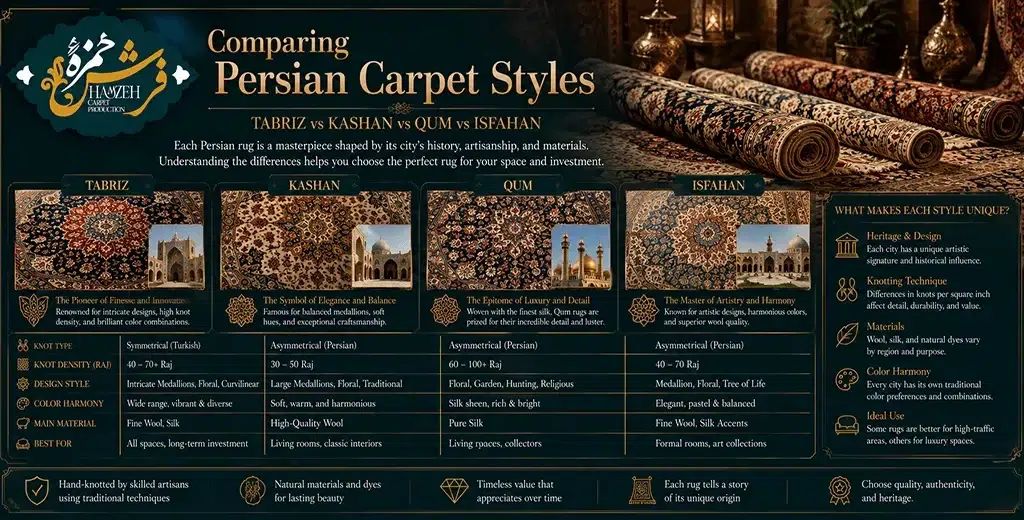
Persian rug comparison is important because choosing a hand-knotted Persian carpet involves much more than just picking a beautiful design and color palette. The true essence of authentic Persian rugs lies in technical factors such as knot type, knot density (Raj), raw materials, weaving techniques, and design genealogy—attributes that directly dictate a rug’s structural quality, durability, market value, and ideal placement.
Among Iran’s legendary weaving centers, Tabriz, Kashan, Qum, and Isfahan hold prestigious positions. Each region is globally recognized for its distinct weaving style, historical motifs, and structural features. Consequently, many buyers and collectors face questions like: What is the difference between Tabriz and Kashan rugs? or How does a Tabriz carpet compare to Qum and Isfahan masterpieces?
This comprehensive guide explores the distinct weaving styles of Persian carpets, with a particular focus on Tabriz rugs. We will analyze and compare them across crucial technical metrics: knotting technique, density, pattern origin, color harmony, raw materials, and practical usage. If you intend to purchase a hand-knotted Persian rug or wish to understand the different schools of Persian weaving, this guide will help you make an informed choice.
Why Do Persian Rug Weaving Styles Vary Across Regions?
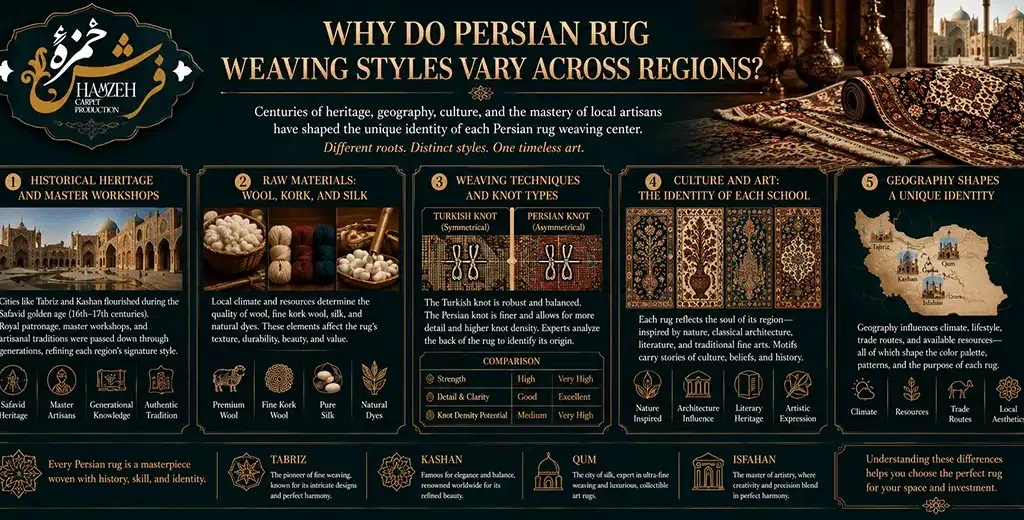
Placing hand-knotted rugs from different Persian cities side by side reveals distinct contrasts in pattern layouts, color saturation, texture fineness, and structural execution. These variations are the product of centuries of localized heritage, cultural developments, geographic conditions, and the generational expertise of regional master weavers who shaped their unique local identities.
Historically, each weaving hub relied on indigenous materials and localized tools. The local wool quality, silk availability, natural vegetable dyes, and even regional aesthetic preferences gradually forged a distinct identity for each area. Today, carpet experts can determine a rug’s exact origin simply by assessing its structural anatomy and weave characteristics.
Historical Heritage and Master Workshops
The historical background of each city plays a vital role in its weaving school. Hubs like Tabriz and Kashan have been vital centers of Persian carpet weaving since the Safavid golden age ($16\text{th–}17\text{th}$ centuries), showcasing refined skill and deep authenticity passed down through generations. Conversely, Qum, despite its shorter history, has carved out a premium niche by specializing in ultra-fine, luxurious silk rugs that target modern art collectors.
Raw Materials: Wool, Kork, and Silk
The quality of wool, fine kork wool, and silk, along with dye quality, directly impacts a rug’s texture, longevity, and financial value. Some regions leverage high-grade local wool for robust, highly durable rugs meant for heavy foot traffic, while others utilize premium silk for delicate, museum-quality art pieces. The final quality depends heavily on both the raw material and the technical skill of the weaver.
Weaving Techniques and Knot Types
The two primary knots used in Persian weaving are the Turkish knot (symmetrical) and the Persian knot (asymmetrical). Each knot yields different structural properties, affecting the rug’s overall tensile strength, design crispness, and weave density. Experts evaluate the knot structure on the reverse side of the rug to identify its exact weaving school.
Culture and Art: The Identity of Each Weaving School
A hand-knotted rug is more than just a floor covering; it is a mirror reflecting the culture, art, and history of its region. Many Persian rug patterns draw inspiration from nature, classical architecture, and traditional fine arts. Understanding these differences simplifies the process of selecting the perfect rug. Next, we will examine the unique properties of the Tabriz weaving style to see why it remains one of the most influential schools of Persian carpet weaving.
Defining Characteristics of Hand-Knotted Tabriz Rugs
The Tabriz school of weaving is celebrated worldwide for its unmatched versatility, technical precision, and structural integrity. Unlike other regions tied to a singular rigid style, Tabriz workshops produce everything from rugged, utilitarian flooring to ultra-fine, investment-grade silk masterpieces.
A Heritage Woven into the Warp and Weft
Tabriz has historically served as a critical hub for global trade and fine art in Persia. During the Safavid era, it became a royal manufacturing center for court carpets. This rich historical background ensures that Tabriz rugs maintain a highly respected status among global carpet enthusiasts and auction houses today.
The Symmetrical Turkish Knot
Most Tabriz carpets are woven using the Turkish knot, utilizing a specialized metal hook (Gholab) for speed and extreme geometric precision. This results in a highly durable, structured, and uniform weave. While the knot type alone does not define quality, it works in tandem with raw materials, density, and final shearing to determine the rug’s ultimate value.
Expert Trade Secret: To properly judge a rug’s weaving quality, experts always examine the reverse side. The neatness, consistency, and alignment of the knots offer critical information regarding the structural integrity of the piece.
Design Versatility: The Defining Trait of Tabriz
If there is one defining characteristic of Tabriz rugs, it is their massive variety of motifs. Unlike regions limited to a specific pattern, Tabriz features layouts such as Mahi (Herati/Fish), Lachak-Toranj (medallion and corners), Afshan (overall floral), hunting scenes, tree of life, and highly complex pictorial rugs (miniatures). This versatility makes Tabriz rugs perfect for both traditional layouts and modern interior designs.
The Raj (Knot Density) System
Tabriz uses a unique density metric called Raj (the number of knot rows within a linear span of approximately $7 \text{ cm}$ on the back of the rug). Tabriz rugs range from commercial $30\text{-Raj}$ options up to incredibly fine museum-quality $50\text{-Raj}$, $70\text{-Raj}$, or even $80\text{-Raj}$ compositions. However, a high Raj count must be matched by high wool quality and proper finishing to be truly valuable.
Raw Materials and Contemporary Color Palettes
Tabriz rugs incorporate high-quality wool, fine kork, and pure silk highlights, creating options across various price points. In terms of coloration, besides classic deep madder reds, indigos, and creams, contemporary Tabriz workshops weave carpets with soft, pastel, and light color tones designed to blend effortlessly into modern, minimalist homes.
Why Tabriz Rugs Maintain Global Popularity
The popularity of Tabriz rugs stems from a combination of durability, design diversity, structural strength, and market adaptability. Whether you seek an everyday rug that can withstand heavy traffic or a fine collectible piece, the Tabriz weaving school provides reliable value.
Tabriz vs Kashan rugs
Tabriz and Kashan represent two of Iran’s oldest and most prestigious carpet-weaving capitals, yet they possess contrasting design philosophies and structural foundations.
Knot and Structural Differences
The most prominent difference lies in the knot execution. Tabriz relies heavily on the symmetrical Turkish knot, which yields a highly rigid and structurally aligned weave. In contrast, Kashan weavers traditionally utilize the asymmetrical Persian knot. This knot type allows the weaver to create fluid, curvilinear movements, which are essential for executing fine, rounded floral paths.
Design and Motif Contrasts
Tabriz is highly diverse and adapts quickly to changing global design trends. Kashan rugs stick firmly to deep-rooted, classical formats. The iconic Shah Abbasi scrollwork, repetitive Afshan patterns, and traditional central medallions dominate Kashan weaving, bringing a majestic, deeply traditional, and formal atmosphere to a room.
Color Palette and Tone Variations
Kashan carpets are globally famous for their loyalty to rich, warm, and highly traditional color schemes—principally deep madder reds (Laki), dark indigos, rich ivories, and deep burgundies. Tabriz, on the other hand, embraces an experimental palette, frequently incorporating modern light grey, beige, pastel, and muted tones alongside traditional colorways.
Practical Placement and Usage
If you require a durable, highly resilient rug for an area with daily foot traffic, a high-quality wool Tabriz rug is an excellent choice due to its dense knotting structure. If you wish to build an interior around classical Persian warmth and traditional aesthetics, a Kashan rug offers deep historical authenticity.
Common Buyer Misconception: Contrary to public belief, a Tabriz rug is not inherently superior or more expensive than a Kashan rug. The real market value depends heavily on the specific knot density (Raj), the percentage of silk or fine kork used, weave accuracy, age, and general preservation status.
Tabriz vs. Qum (Silk) Rugs
The comparison between Tabriz and Qum is fundamentally a comparison of vast versatility versus ultra-luxurious, delicate specialization.
Weave Fineness and Knot Density
Tabriz produces a broad spectrum of densities starting from moderate commercial tiers. Qum, however, focuses almost exclusively on ultra-high knot counts. Weaved with extreme precision, Qum rugs feature miniature-style, highly complex layouts that occupy a premium space among fine textiles.
Material Luxury and Foundation Types
While Tabriz employs a functional mix of wool, fine kork, and silk accents, Qum is internationally synonymous with pure silk rugs (often featuring both a pure silk foundation/warp, known as Cheleh, and a pure silk pile). Qum rugs have a signature brilliant sheen, a feather-light weight, and a highly supple texture that handles like fine fabric.
Design Layouts and Detailing
Tabriz designs scale from large geometric patterns to delicate pictorials. Qum rugs are defined by intricate, micro-detailed layouts. They utilize delicate arabesques (Eslimi), spiraling vines (Khatai), and miniature floral arrangements that require incredible knot density to remain sharp and legible.
Application and Preservation Needs
Thanks to their robust Turkish knotting and sturdy wool construction, Tabriz rugs excel in active residential environments. Qum silk rugs, due to their delicate pile and immense artistic value, are predominantly treated as fine wall art, decorative tapestries, or reserved for low-traffic luxury spaces and elite collections where they are protected from heavy wear and stains.
Crucial Note: A rug being made of silk does not mean it is automatically better for your home. Silk rugs hold supreme artistic and investment value, but a premium wool-and-silk Tabriz rug provides vastly superior structural resilience under regular walking conditions.
Tabriz vs Isfahan rugs
Isfahan and Tabriz both represent the absolute pinnacle of Persian structural craftsmanship, but they differ greatly in their execution of design balance and mathematical harmony.
Weaving Architecture and Knot Styles
Most Tabriz carpets are woven with the Turkish knot and feature a dense, double-wefted structure. Isfahan rugs are traditionally crafted using the fine asymmetrical Persian knot on ultra-fine silk or cotton foundations. Isfahan rugs feature a very low, precisely sheared pile height, giving them a thin feel but incredibly sharp design definition.
Design Geometry and Architectural Inspiration
Tabriz designs focus on thematic variety and eclectic storytelling layouts. Isfahan carpets are famous for their flawless symmetry and mathematical elegance. They draw heavy inspiration from the majestic tile work of historic Safavid monuments, such as the dome of the Sheikh Lotfollah Mosque. Their fluid arabesques and spiraling vines are masterfully balanced with perfect symmetry.
Color Harmony and Tone Balancing
Tabriz utilizes contrast and varying color intensities across modern and classic palates. Isfahan rugs favor premium color balance, relying on soft, regal combinations of ivory, turquoise, beige, royal indigo, and soft rose. This precise color selection gives Isfahan carpets a highly formal, aristocratic, and elegant presence.
Materials and Traffic Resistance
Both schools utilize wool, fine kork, and silk. Isfahan master workshops are famous for using premium kork wool outlined with pure silk threads to create a three-dimensional visual effect. Tabriz rugs are heavier and structurally firmer underfoot, making them versatile for multiple room types, whereas Isfahan rugs are favored for formal reception halls and classical salons.
Summary Comparison Table: Persian Rug Schools
| Technical Criteria | Tabriz Rugs | Kashan Rugs | Qum Rugs | Isfahan Rugs |
| Knot Type | Symmetrical (Turkish) | Asymmetrical (Persian) | Mostly Asymmetrical | Asymmetrical (Persian) |
| Knot Density (Raj) | Highly Varied ($30\text{–}80\text{ Raj}$) | Medium to High ($35\text{–}50\text{ Raj}$) | Exceptionally High ($60\text{–}90\text{ Raj}$) | Ultra-High & Fine ($50\text{–}80\text{ Raj}$) |
| Primary Materials | Wool, Fine Kork, Silk | Wool, Kork, Cotton Foundations | 100% Pure Silk, Fine Kork | Premium Kork Wool, Silk accents |
| Design Style | Highly Versatile & Adaptive | Classic, Formal, Traditional | Intricate, Miniature-detailed | Symmetrical, Mosque Architecture |
| Signature Motifs | Mahi (Fish), Medallions, Pictorial | Shah Abbasi, Overall Afshan | Eslimi, Hunting, Small Medallions | Dome Patterns, Arabesques, Vines |
| Color Scheme | Infinite (Vibrant to Light/Pastel) | Deep Madder Reds, Indigo, Ivory | Luminous, Bright Jewel Tones | Balanced Turquoises, Ivories, Blues |
| Structural Durability | Exceptional (High Foot Traffic) | Very Good (Resilient Pile) | Delicate (Low Pile, High Care) | Excellent (Dense Kork Construction) |
| Best Suited For | Daily Living Areas to Collections | Traditional Living Rooms & Salons | Wall Hangings & Fine Collecting | Formal Reception Halls & Luxury Spaces |
Which Weaving Style Best Suits Your Home?
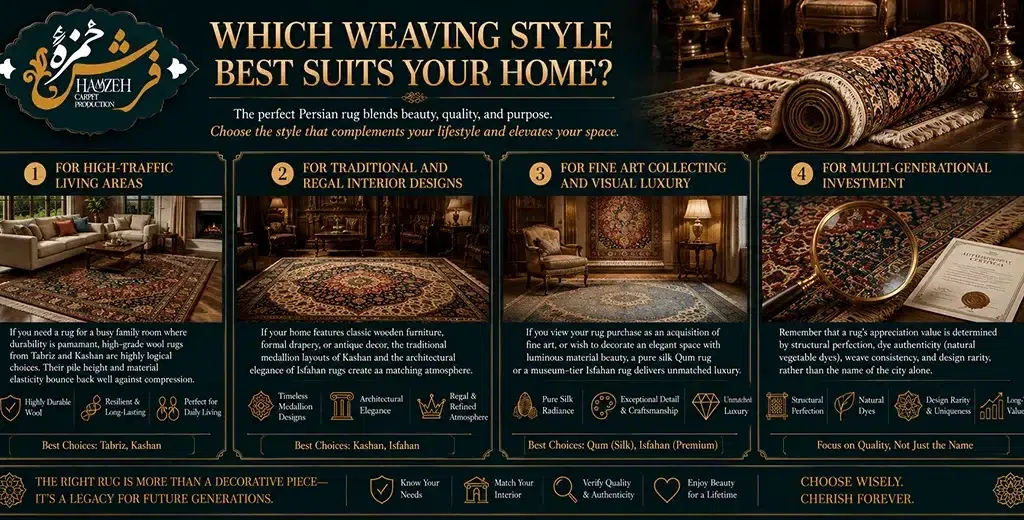
Determining the ideal hand-knotted Persian carpet depends on your practical requirements, aesthetic preferences, budget, and intended room placement.
- For High-Traffic Living Areas: If you need a rug for a busy family room where durability is paramount, high-grade wool rugs from Tabriz and Kashan are highly logical choices. Their pile height and material elasticity bounce back well against compression.
- For Traditional and Regal Interior Designs: If your home features classic wooden furniture, formal drapery, or antique decor, the traditional medallion layouts of Kashan and the architectural elegance of Isfahan rugs create a matching atmosphere.
- For Fine Art Collecting and Visual Luxury: If you view your rug purchase as an acquisition of fine art, or wish to decorate an elegant space with luminous material beauty, a pure silk Qum rug or a museum-tier Isfahan rug delivers unmatched luxury.
- For Multi-Generational Investment: Remember that a rug’s appreciation value is determined by structural perfection, dye authenticity (natural vegetable dyes), weave consistency, and design rarity, rather than the name of the city alone.
Final Summary and Conclusions
The hand-knotted carpets of Tabriz, Kashan, Qum, and Isfahan represent the absolute peak of Iranian cultural art. Their true distinctions extend far beneath the surface, rooted deeply in knot selection, density metrics, material choices, and historical design philosophies.
If you value immense design choice, robust structural strength, and flexible sizing, Tabriz is a premier option. Kashan satisfies those drawn to warm, traditional layouts; Qum stands out for luxurious silk detailing; and Isfahan offers breathtaking mathematical harmony and regal elegance. Always inspect both the front design and the reverse knot alignment before finalized purchases to secure an authentic piece of Persian heritage.
Frequently Asked Questions (FAQ)
What is the main technical difference between Tabriz and Kashan rugs?
The primary distinction lies in the knot type and color choices. Tabriz carpets use the symmetrical Turkish knot and offer highly varied contemporary and traditional patterns. Kashan rugs use the asymmetrical Persian knot and focus heavily on classical layouts rendered in deep reds, indigos, and ivories.
Can a Qum silk rug be placed under heavy furniture?
It is not recommended. Pure silk Qum rugs have a delicate foundation and low pile height. Heavy furniture legs can compress the silk fibers permanently or warp the foundation. They are best displayed as wall hangings or placed in formal, low-traffic areas.
What does “Raj” mean in a Persian carpet specification?
Raj is a technical unit of measurement used to calculate knot density, specifically in the Tabriz school. It counts the number of knot nodes within a linear span of roughly $7 \text{ cm}$. A higher Raj count signifies a finer, tighter, and more valuable weave.
How do carpet experts instantly identify a rug’s origin?
Experts read the rug’s structural blueprint. By examining the knot type from the back, analyzing the thickness and material of the weft lines, observing the pile shearing style, and identifying regional design elements, they can determine the origin with high accuracy.