
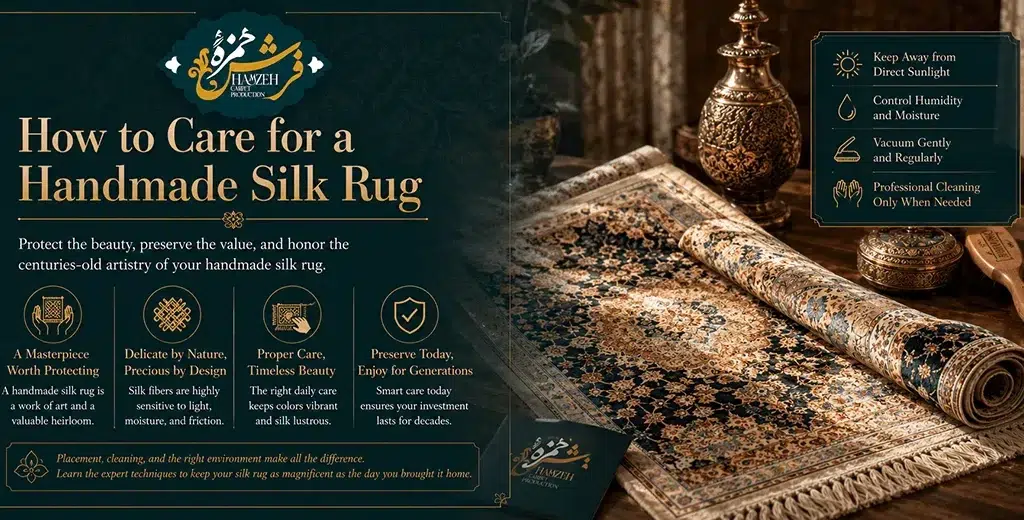
Learning how to care for a handmade silk rug is essential if you want to protect a luxury masterpiece, preserve a fine financial asset, and honor centuries-old weaving traditions. A handmade silk rug is far more than a luxury floor covering. It is a masterpiece of art, a reflection of generations of craftsmanship, and a highly valuable financial asset. The natural sheen of real silk, the microscopic precision of the knots, and the rich depth of the organic dyes give these rugs an unparalleled elegance.
However, natural silk fibers are structurally delicate. Unlike wool or synthetic materials, silk is highly sensitive to its environment. Without learning the proper techniques on how to care for a handmade silk rug, a prized textile can experience severe color changes, loss of luster, or permanent structural damage in a surprisingly short amount of time.
Many collectors believe that an occasional wash is enough to preserve their investment. In reality, everyday factors—like where you place the rug, how you vacuum it, and even the ambient humidity of your room—play a critical role in its longevity. This comprehensive guide combines generational expertise with modern textile preservation techniques to teach you exactly how to care for a handmade silk rug to protect your investment for decades to come.
Why You Must Learn How to Care for a Handmade Silk Rug
The value of a Persian or oriental silk rug isn’t just determined by the cost of raw silk materials; it represents months, sometimes years, of intense, highly skilled labor. A single mistake in daily maintenance can permanently lower both its aesthetic beauty and its market value. If you read our comprehensive silk rug buying guide, you already know that the complexity of the weave dictates its baseline value, making a dedicated preservation routine vital.
Because silk is a natural protein fiber, it reacts strongly to environmental stressors. High UV exposure breaks down the fiber walls, while improper chemical exposure can strip the natural oils that give silk its famous shimmering glow.
Furthermore, high-end handmade rugs function as appreciating capital assets. If you master how to care for a handmade silk rug and extend the lifespan of a handmade rug through standard care, the piece will actually gain value as it ages, evolving from a household luxury into a highly sought-after antique for future generations.
Natural Silk vs. Wool Rugs: Care Comparison
When comparing these two textiles, understanding how to care for a handmade silk rug requires a completely different level of precision than caring for wool. While both styles represent peak traditional craftsmanship, silk requires a completely different level of precision than wool. The table below outlines how their maintenance needs diverge:
| Care Factor | Handmade Silk Rug | Handmade Wool Rug |
| Cleaning Type | Requires highly specialized, pH-neutral professional washing. | Can tolerate gentle, traditional washing methods. |
| Sun Resistance | Highly Sensitive (Prone to rapid, severe fading). | Moderate to high resistance. |
| Chemical Tolerance | Harsh chemicals or high pH destroy the protein fibers instantly. | Higher natural resilience to pH fluctuations. |
| Stain Vulnerability | Liquid bonds quickly; requires immediate, delicate blotting. | Easier to treat due to wool’s natural lanolin coating. |
| Pile Compression | Heavy furniture causes permanent, stubborn fiber indentation. | Highly resilient fibers that spring back quickly. |
Deep Dive: The Unique Properties of Natural Silk Fibers
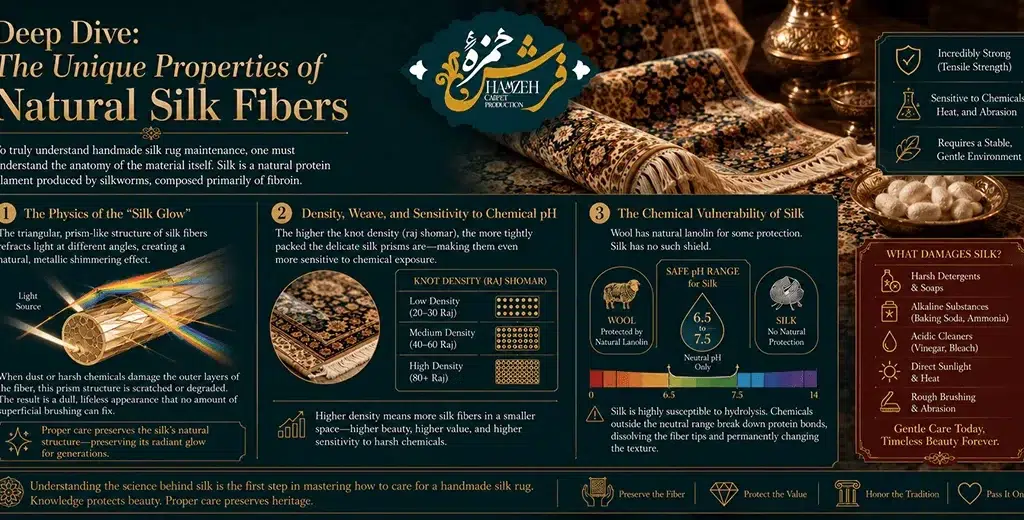
To truly understand handmade silk rug maintenance, one must understand the anatomy of the material itself. Silk is a natural protein filament produced by silkworms, composed primarily of fibroin. Structurally, it is one of the strongest natural fibers in the world regarding tensile strength. However, this strength only applies to pulling forces—not to chemical, thermal, or abrasive environmental forces.
The Physics of the “Silk Glow”
The reason a Persian silk rug changes its color intensity depending on the angle you view it from is due to the triangular, prism-like structure of the silk fiber. This structure refracts light at different angles, producing a natural, metallic shimmering effect.
When dust particles settle deep within the pile or when harsh chemical cleaners strip away the outermost protective layers of the fiber, this prism structure is permanently scratched or degraded. The result is a dull, lifeless appearance that no amount of superficial brushing can fix. Understanding how to care for a handmade silk rug preserves this structural geometry, ensuring the rug keeps its signature glow for centuries.
Density, Weave, and Sensitivity to Chemical pH
The delicate nature of the fiber is closely linked to its density. For instance, discovering what is raj shomar helps you understand the knot density of a rug; the higher the density, the more tightly packed these delicate silk prisms are. This dense chemical vulnerability is a core reason why knowing how to care for a handmade silk rug involves staying away from standard household detergents.
Wool fibers possess a natural coating of lanolin, which offers a brief window of protection against acidic or alkaline spills. Natural silk possesses no such shield. Silk fibers are highly susceptible to hydrolysis—a chemical reaction where the protein bonds break down when exposed to substances outside a narrow, neutral pH range ($6.5$ to $7.5$). This is why traditional laundry detergents, alkaline baking soda, or acidic spot treatments can physically dissolve the delicate tips of the silk pile, changing the texture permanently.
Essential Rules on How to Care for a Handmade Silk Rug Daily
Proper care relies far more on consistent, daily prevention than it does on aggressive cleaning. Implementing these baseline principles will eliminate the vast majority of common rug hazards.
How to Care for a Handmade Silk Rug via Strategic Placement
Keep your silk rugs out of high-traffic zones like entryways, hallways, or dining rooms. Footwear creates heavy friction that wears down the delicate pile over time. Additionally, keep them away from areas prone to spills, such as kitchens or spaces where pets frequent.
Ideally, a masterfully woven silk rug should be placed in formal sitting rooms, master bedrooms, or even hung as a wall tapestry where it can be admired without facing physical friction. If placed on the floor, implement a strict “no shoes” policy within the room to prevent outdoor grit from entering the fabric matrix.
2. Shielding from Direct Sunlight and UV Damage
One of the most frequent reasons owners ask, “Why is my silk rug changing color?” is prolonged exposure to ultraviolet (UV) rays. Direct sunlight bleaches natural, organic vegetable dyes and makes silk fibers brittle.
- Use sheer curtains, blinds, or UV-filtering window films on sunny windows.
- The Rotation Rule: Turn your rug 180 degrees every six months. This ensures that even if there is ambient light exposure, the rug wears and ages completely evenly, avoiding jarring, localized faded patches.
3. Controlling Environmental Humidity and Temperature
As a protein-based textile, silk acts like a sponge for moisture. Excessively humid rooms invite mold, mildew, and dry rot, which destroys the foundation threads. Conversely, an overly dry environment makes the silk brittle.
Optimal Climate Control: Maintain a relative indoor humidity between 40% and 60%. If you live in a coastal or highly humid region, using a dehumidifier in the rug room is an excellent protective step.
Furthermore, keep the rug away from direct heat sources such as radiators, underfloor heating vents, or fireplaces. High temperatures accelerate the drying out of the structural core, leaving the warp and weft fibers prone to snapping under minimal pressure.
4. Minimizing Heavy Furniture Pressure
Placing the heavy legs of sofas, cabinets, or tables directly onto a silk rug crushes the knots and distorts the pile permanently. If you must place furniture on the rug, use wide, dedicated felt or wood furniture cups to distribute the weight across a larger surface area. Even with protectors, shift the furniture slightly by a few inches every few months to give the fibers a chance to recover.
5. Investing in a Premium Rug Pad
A top-tier rug pad is not optional for a luxury silk rug. A proper pad serves two critical roles: it prevents the rug from slipping (which causes structural stress on the backing), and it acts as a shock absorber, cushioning the delicate silk fibers from being crushed between footsteps and a hard subfloor. Avoid cheap rubber or adhesive pads, which can chemically degrade and stick to the back of the rug. Opt instead for a solid felt or dense felt-and-fretwork non-slip pad.
How to Clean a Persian Silk Rug Safely
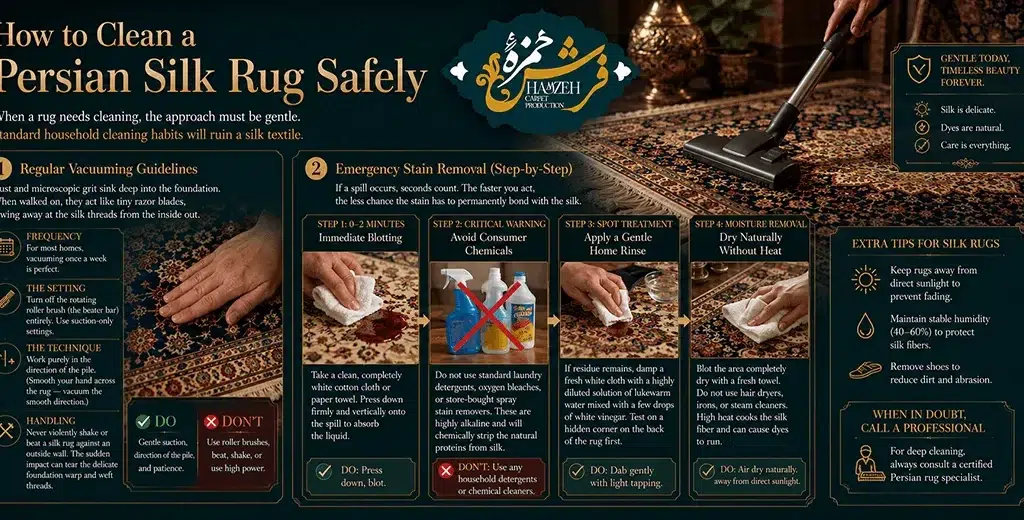
When a rug needs cleaning, the approach must be gentle. Standard household cleaning habits will ruin a silk textile.
1. Regular Vacuuming Guidelines
Dust and microscopic grit don’t just sit on top of the rug—they sink deep into the foundation. When walked on, these sharp dust particles act like tiny razor blades, sawing away at the silk threads from the inside out.
- Frequency: For most homes, vacuuming once a week is perfect.
- The Setting: Turn off the rotating roller brush (the beater bar) entirely. Use suction-only settings. The spinning bristles of a vacuum brush will tear, fray, and fuzzy the delicate silk pile.
- The Technique: Work purely in the direction of the pile (smooth your hand across the rug; the direction that feels smooth is the direction to vacuum).
- Handling: Never violently shake or beat a silk rug against an outside wall. The sudden impact can easily tear the delicate foundation warp and weft threads.
2. Emergency Stain Removal (Step-by-Step)
If a spill occurs, seconds count. The faster you act, the less chance the stain has to permanently bond with the silk protein structure.
- Immediate Blotting (Step 1: 0-2 Minutes): Take a clean, completely white cotton cloth or heavy-duty paper towel. Press down firmly and vertically onto the spill to absorb the liquid. Never rub or wipe side-to-side. Rubbing pushes the liquid deeper into the knots and spreads the stain laterally.
- Avoid Consumer Chemicals (Step 2: Critical Warning): Do not touch standard laundry detergents, oxygen bleaches, or store-bought spray stain removers. These formulas are highly alkaline, which chemically strips the natural proteins out of silk, causing instant, permanent color bleeding.
- Apply a Gentle Home Rinse (Step 3: Spot Treatment): If the stain leaves residue, damp a fresh white cloth with a highly diluted solution of lukewarm water mixed with a few drops of white vinegar. Test this on a hidden corner on the back of the rug first to ensure the dyes don’t run. Gently dab the stained area using light, vertical tapping motions.
- Dry Naturally Without Heat (Step 4: Moisture Removal): Blot the area completely dry with a fresh towel. Do not use hair dryers, irons, or steam cleaners. High heat cooks the silk fiber and can cause the surrounding organic dyes to run into one another. Let it air dry naturally, away from direct sunlight.
Professional Silk Rug Cleaning: When and How?
Even with pristine home care, fine rugs eventually require deep cleaning. However, this is an art form best left to certified conservation specialists.
Recommended Washing Frequency
A silk rug should only be washed when it actively exhibits signs of deep-seated soil. If kept in a formal, low-traffic sitting room, a professional wash every 3 to 5 years is completely sufficient. Washing too frequently creates unnecessary wear on the organic dyes and structure.
Why DIY Home Washing is Risky
Washing a silk rug on a driveway or in a backyard is a recipe for disaster. When wet, natural silk loses a portion of its structural strength. Without specialized extraction equipment, the rug stays wet too long, leading to dye migration (color bleeding) and warping of the rug’s shape. Professional conservators utilize custom pH-balanced shampoos, rapid low-temperature drying rooms, and specialized wash pools designed explicitly for delicate fabrics.
5 Signs It’s Time to Call a Specialist
- Dye Migration: You notice colors subtly bleeding into adjacent white or cream sections.
- Stiffness: The pile feels rough, crusty, or stiff when you run your hand over it.
- Lingering Odors: A musty or damp smell coming from the rug fibers.
- Deep Stains: Stubborn spots from coffee, wine, or pet accidents that don’t lift with gentle blotting.
- Embedded Grime: The colors look dull and hazy, even immediately after a careful vacuum session.
Comprehensive Long-Term Storage Strategies
Many collectors choose to rotate their fine textile collections, keeping some pieces on display while storing others. Storing a handmade silk rug requires a dedicated strategy to protect it from dark, stagnant environments where pests thrive. If you are stepping away from active display, learning how to care for a handmade silk rug during long-term storage is vital to prevent moth damage.
The Dangers of Airtight Plastic
One of the most catastrophic mistakes in handmade silk rug maintenance is wrapping a stored rug in heavy industrial stretch wrap or airtight plastic bags. Textiles need to breathe.
When temperature fluctuations occur in a storage unit or closet, the air trapped inside plastic creates condensation. This microscopic moisture layer has nowhere to escape, creating a perfect environment for mildew, fungal dry rot, and bacterial colonies that digest the silk fibers within months.
The Correct Archival Storage Protocol
To protect your rug for years in storage, follow these step-by-step preservation instructions:
- Clean Before Storing: Never store a dirty rug. Embedded dust particles will settle and compact over time, making them nearly impossible to remove later. Ensure the rug is professionally cleaned and 100% dry.
- Roll Correctly: Roll the rug tightly along its length, starting from the bottom (the end opposite the natural slope of the pile) with the pile facing inward. Never fold a silk rug, as it cracks the foundation cords.
- Wrap in Breathable Material: Encase the rolled rug in a breathable, unbleached cotton sheet, muslin fabric, or heavy archival wrapping paper. This shields the textile from dust while allowing full air circulation.
- Elevate from the Ground: Store the rug horizontally on a shelf or raised platform. Never store a rug standing vertically on its end, as the weight will buckle the lower edges, permanently distorting the shape. Never store it directly on concrete floors, which leach moisture upward.
- Climate Control: Choose a dark, cool, and climate-controlled closet or storage vault. Avoid uninsulated attics or damp basements.
Common Silk Rug Damages and Prevention
- Color Changes & Fading: Caused by UV damage. Prevention: Rotate the rug regularly and invest in window tints or drapery.
- Loss of Sheen: Caused by microscopic dust friction. Prevention: Consistent suction-only vacuuming and ensuring a shoes-off policy in the room.
- Dry Rot: Caused by placing plants on the rug or leaving it in a damp basement. Prevention: Never place potted plants on a fine rug, even with plastic trays, as condensation will form underneath.
- Moth Damage: Silk-wool blend rugs are incredibly enticing to clothes moths. Prevention: Inspect the back of the rug and the areas hidden under furniture at least once every three months.
- Edge and Fringe Fraying: The fringes are the extension of the rug’s internal foundation. If they unravel, the knots will begin to slide off. Prevention: If you see a loose thread or broken fringe, take it to a restorer immediately before the damage creeps into the main body of the rug.
Top Mistakes to Avoid in Silk Rug Care
- Folding the Rug: Never fold a silk rug for transport or storage. Folding creates severe creases that can crack the foundation threads. Always roll the rug tightly, pile facing inward, in the direction of the pile.
- Using Abrasive Stain Brushes: Scrubbing a stain with a plastic-bristled brush or a rough sponge tears the outer cuticle of the silk fiber. This creates a fuzzy, matted patch that permanently reflects light differently, ruining the uniform look of the design.
- Ignoring Minor Issues: A tiny pull in the binding or a small drink spill should be addressed immediately. Small structural issues expand rapidly with foot traffic.
- Treating a Silk Masterpiece as Decorative Flooring: Treating a high-value silk rug like a common synthetic rug leads to neglect. Cultivate a mindset that you are caring for a delicate historic painting that happens to be on the floor.
Frequently Asked Questions (FAQs)
Q1: Does vacuuming damage a silk rug?
Only if done incorrectly. Using a high-powered vacuum with a spinning brush attachment will fray the silk fibers. However, using a low-suction, flat tool moving smoothly in the direction of the pile is entirely safe and highly recommended to remove damaging dust grit.
Q2: How do I fix a dent left by heavy furniture?
Spurt a tiny amount of lukewarm distilled water onto the indentation until the fibers are slightly damp (not soaked). Using a very soft-bristled toothbrush or clean cloth, gently brush the compressed fibers upward in the direction of the natural pile. Allow it to air dry fully before setting anything near it.
Q3: Is a silk rug suitable for a busy living room?
Generally, no. Because of their high value and structural delicacy, they are best suited for formal sitting rooms, bedrooms, or areas with minimal footwear traffic. If placed in a busy living room, it will experience accelerated wear and require much more frequent professional care.
Q4: Is a rug pad actually necessary for silk?
Yes. A high-quality felt pad acts as a protective shield, dampening the impact of footsteps and eliminating the damaging friction created when the back of the rug rubs directly against hard stone, tile, or hardwood floors.
Q5: Can I use commercial dry cleaning powders on a silk rug?
Absolutely not. Consumer dry-cleaning powders and absorbent granules contain chemical solvents and abrasive compounds that can strip the natural hydration out of the silk filaments. They leave behind a powdery residue within the dense knots that attracts moisture and causes the fibers to rot over time.
Conclusion & Expert Consultation
Ultimately, mastering how to care for a handmade silk rug comes down to consistent, gentle prevention. Caring for a handmade silk rug requires a balance of regular prevention, gentle cleaning techniques, and knowing when to let the experts step in. By controlling light, monitoring humidity, vacuuming carefully, and acting fast during emergencies, you ensure that this exquisite blend of art and investment maintains its radiant color and financial value for generations.
If you own a luxury handmade silk rug that requires professional deep cleaning, delicate stain removal, or expert restoration work, the master craftsmen at Hamzeh Carpet are here to help. With decades of hands-on experience preserving the finest Persian and oriental textiles, we provide the specialized, museum-grade care your masterpiece deserves. Contact us today for a professional consultation.