
Buying a hand- Pknottedersian rug is much more than purchasing a decorative piece for your home. An authentic Persian carpet is often a long-term investment, a work of art, and a valuable heirloom passed down through generations. Still, once you start browsing rug galleries or shopping online, you’ll run into technical terms that can feel confusing at first.
One of the most important is rug knot density, known in the Persian carpet industry as Raj Count.
You’ve probably heard phrases like “this is a 50 Raj carpet” or “this Qom rug has a 70 Raj weave.” So what is rug knot density, and why does it matter so much for the quality, craftsmanship, artistic value, and price of a hand-knotted Persian rug?
In simple terms, rug knot density — sometimes called knot density in Persian rugs — refers to the number of knots woven within a standard measurement of the rug’s width. It’s one of the most reliable indicators of how fine the weave is. Generally, a higher knot density allows for more detail in the design, smoother curves, and more intricate patterns.
In this guide from Danesh Carpet Magazine, you’ll learn what rug knot density is, how to measure rug knot density, how it influences a rug’s value, and how to evaluate it like a professional before your next purchase.
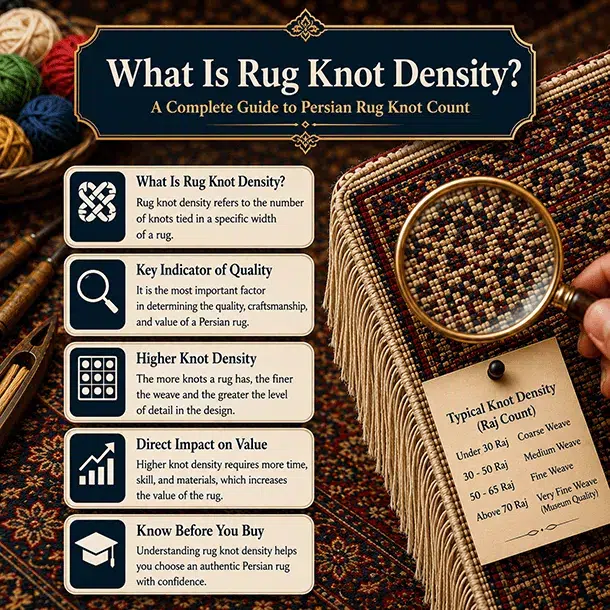
Rug knot density refers to the number of hand-tied knots woven within a standard measuring unit of a handmade rug. In Persian carpets, this measurement is traditionally known as Raj Count, and it helps indicate the fineness of the weave, the level of detail in the design, and the amount of craftsmanship involved.
Why Understanding What Is Rug Knot Density Matters Before Buying a Persian Rug
Most buyers naturally focus on a rug’s design, colors, or size first. Those things matter, but understanding what rug knot density is gives you a much clearer picture of a rug’s true quality and craftsmanship — beyond how it looks in a photo.
Many first-time buyers judge a rug on appearance or price alone. Professional rug appraisers and experienced Persian carpet dealers evaluate far more than a rug’s appearance. One of the first characteristics they examine is knot density, because it provides valuable insight into the quality of the weave.
Knowing this also lets you compare rugs more objectively. Two carpets can look nearly identical at first glance, yet one might contain far more knots and require significantly more skill and time to produce. That gap is often what separates two very different price tags.
That said, knot density isn’t the only measure of quality. Wool or silk quality, natural dye quality, weaving consistency, and the weaver’s skill all matter just as much. In fact, a well-made 40 Raj wool rug can outperform a 70 Raj silk rug in a high-traffic hallway, simply because it’s built for durability rather than delicacy.
Once you understand Persian carpet knot count, you stop relying entirely on a seller’s word for it — you can assess the weave yourself and buy with more confidence.
If you’re planning to buy an authentic Persian rug, we also recommend our Complete Guide to Buying an Authentic Handmade Persian Rug, which covers materials, weaving techniques, dye quality, regional styles, and practical buying tips.
Rug Knot Density Explained in Simple Terms
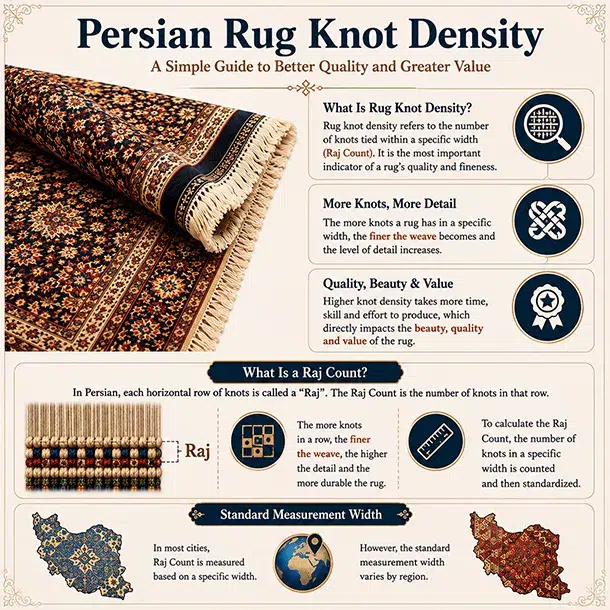
Put simply: rug knot density is the main measurement used to determine how fine and compact the weave of a hand-knotted Persian rug is.
Machine-made rugs are usually described with terms like “face density” or “points.” Traditional Persian carpets, on the other hand, use Raj Count (Raj) to express weaving fineness.
In carpet weaving, each horizontal row of knots is called a Raj. Count the knots within a standard measuring unit, and you get the rug’s Raj Count — its knot density. The higher the Raj Count, generally speaking, the finer the weave and the more detailed the finished design.
A high-density Persian rug often looks like a finely painted artwork, with graceful curves and intricate floral patterns a coarser weave couldn’t reproduce. One catch worth knowing early: the standard measuring unit for Raj Count isn’t identical everywhere in Iran, so Raj values from Tabriz, Isfahan, and Nain don’t always translate directly into one another.
Understanding the Structure of a Persian Rug: Warp, Weft, and Knots
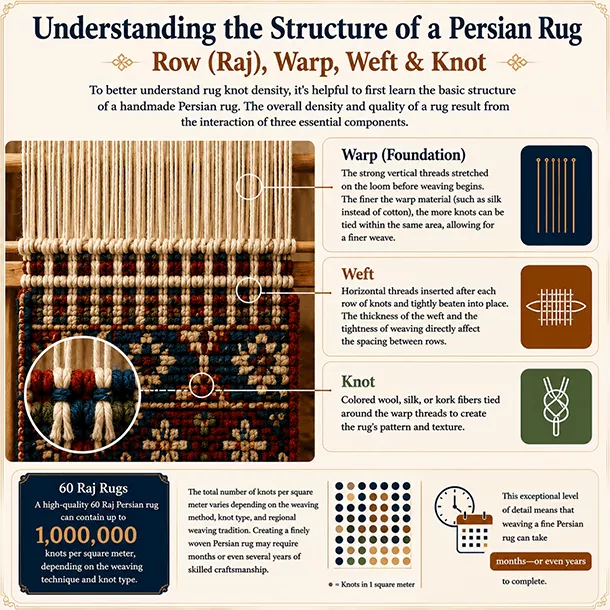
To really understand rug knot density, it helps to know the basic anatomy of a hand-knotted Persian rug. Overall weave density comes from the interaction of three components.
Warp — The strong vertical foundation threads stretched on the loom before weaving begins. Warp is usually cotton, though silk is used in exceptionally fine rugs. The finer the warp, the greater the potential knot density.
Weft — The horizontal thread inserted after each completed row of knots. It locks the knots in place and adds stability. How thick the weft is, and how firmly it’s beaten down, directly affects how compact the weave becomes.
Knots — Individual wool, silk, or wool-silk fibers tied around the warp threads. These form the visible pattern and, ultimately, determine the rug’s knot density.
A finely woven 60 Raj Persian rug can contain several hundred thousand knots — and in exceptional silk carpets, nearly one million knots per square meter. That level of craftsmanship is exactly why weaving one high-quality Persian rug can take months, or even several years.
How to Measure Rug Knot Density (Raj Count)

Measuring rug knot density doesn’t require years of experience. Once you know the method, you can estimate the fineness of a hand-knotted Persian rug with nothing more than a ruler. Here’s the process professional rug experts actually use.
Step 1: Turn the rug over
Trying to count knots from the front is nearly impossible — the pile hides most of the weave. The back reveals every knot clearly, which is why rug dealers often call the back of a Persian rug its “true identity card.” It’s the most accurate place to evaluate Persian carpet knot count and overall weaving quality.
Step 2: Identify the standard measuring unit
Historically, Persian weavers used a unit called the Zar. Today, Raj Count is still tied to regional weaving traditions, so the measuring length varies slightly by city:
Tabriz (Turkish knot tradition): knots counted within 7 centimeters
Isfahan, Kashan, and Nain (Persian knot tradition): knots counted within 6.5 centimeters
That’s why a 50 Raj rug from Isfahan is usually woven a bit finer than a 50 Raj rug from Tabriz. Always factor in the local measuring standard before comparing Raj numbers across cities.
Step 3: Count the knots
Mark off the correct distance, then count every knot across that section. That number is the rug’s Raj Count.
For example: if a Tabriz rug has 50 knots within 7 centimeters, it’s a 50 Raj Persian rug. Fewer knots in that same distance means a coarser weave.
Learning how to measure rug knot density means you can verify a rug’s specs yourself instead of taking the seller’s word for it.
Professional Tools for Measuring Knot Density
A ruler works fine, but professional rug experts usually reach for a rug knot counter (also called a Raj counting magnifier) — a magnifying lens with a precisely measured viewing frame, typically about 2.5 × 2.5 centimeters. Placed against the back of the rug, it lets an expert count knots quickly without worrying about a ruler slipping. This is especially useful on very fine rugs, where hundreds of tiny knots are packed into a small area.
Persian Rug Raj Count Guide
Not every Persian rug is woven to the same fineness — some are built for everyday durability, others as collectible art. Here’s how Persian carpet knot count typically breaks down across the market:
| Characteristics | Weave Type | Raj count |
|---|---|---|
| Thick yarns, durable construction, ideal for high-traffic areas, generally more affordable | Coarse Weave | Under 30 Raj |
| The most common category — a strong balance of durability, comfort, appearance, and value | Medium Weave | 30–50 Raj |
| More detailed patterns, higher knot density, superior craftsmanship, greater artistic value | Fine Weave | 50–65 Raj |
| Exceptionally fine, often pure silk, highly intricate and collectible | Museum Quality | Above 70 Raj |
Rather than asking which Raj Count is “best,” think about how the rug will actually be used. A medium-density wool rug tends to suit family living spaces better; a very high Raj silk rug is better suited to formal rooms or a collection.
How Rug Design Influences Knot Density
Not every design needs the same weaving density. The complexity of a pattern directly affects how many knots it takes to reproduce accurately — which is part of why knot density in Persian rugs varies so much from one style to the next.
Tribal and geometric designs. Traditional tribal rugs — Qashqai, Bakhtiari, or village rugs sometimes called Khersak — feature bold geometric motifs and larger design elements. These patterns don’t need miniature-level precision, so they’re usually woven below 30 Raj. The lower density gives a thicker, softer pile, which also happens to make them more durable for everyday spaces.
Floral, Islimi, and medallion designs. Classic city rugs from Isfahan, Tabriz, Qom, and Kashan often feature intricate floral motifs, arabesques (Islimi), Shah Abbasi flowers, hunting scenes, and elaborate medallions. These designs are full of delicate curves that a coarse weave simply can’t render — go too low on Raj Count and curved lines start looking blocky, with fine details lost entirely. That’s why these pieces are typically woven at 50 Raj or higher.
How Rug Knot Density Affects the Price of a Persian Rug
A common question: why can two Persian rugs of the same size have such different price tags? Knot density is a big part of the answer.
As Raj Count climbs, the number of individual knots rises fast — and every one has to be tied by hand, requiring more precision, patience, and experience from the weaver. A finely woven 60 Raj rug can take several years to complete; an exceptional silk carpet with an even higher density can take longer still. That extra labor is what drives the price up.
But knot density is only one factor. Experienced collectors also weigh:
- Fiber quality (wool, silk, or a wool-silk blend)
- Natural dye quality
- Consistency of the weave
- Regional origin
- Design complexity
- Artistic merit
- Overall condition
That’s why a beautifully woven 40 Raj rug in premium wool can be a smarter investment than a poorly executed 60 Raj piece.?Smart Buying Guide: Which Knot Density Is Right for You
Smart Buying Guide: Which Knot Density Is Right for You?
The right rug knot density depends on how you’ll actually use the rug — not on chasing the highest Raj number you can find.
For a family room, dining area, or other high-traffic space, a 40–45 Raj wool rug is usually the sweet spot: durable, comfortable, well-crafted, and good value for everyday life.
If you’re buying a collector’s piece, a luxury decorative item, or a long-term investment, look toward 50 Raj or higher. These rugs deliver exceptional detail and artistic refinement, though they typically need more careful maintenance.
Either way, weigh knot density alongside fiber quality, dyeing technique, weaving consistency, and the reputation of the weaving region — not on its own.
Regional Terms Used Instead of Raj Count
Raj Count is the most widely recognized term, but some Persian weaving centers use their own local vocabulary.
Nain — “La.” Weaving quality here is described by La, the number of yarn layers in the warp. 6 La rugs use finer yarns and are roughly comparable to 60 Raj or higher; 9 La rugs are medium-fine, corresponding to about 40–45 Raj; 12 La rugs are coarser and more affordable. The lower the La number, the finer the rug.
Isfahan — “Khaft.” Some Isfahan experts describe density using Khaft, the total knot count across the rug’s width rather than the standard Raj measurement. You’ll mostly encounter this buying directly from local workshops.
Kashan — “Khaneh.” Older Kashan merchants sometimes used Khaneh, historically the knot count across half the rug’s width. Raj Count is now the standard term in most professional markets, but it’s worth recognizing this term if you’re dealing in antique or regional pieces.
Common Mistakes When Evaluating Rug Knot Density
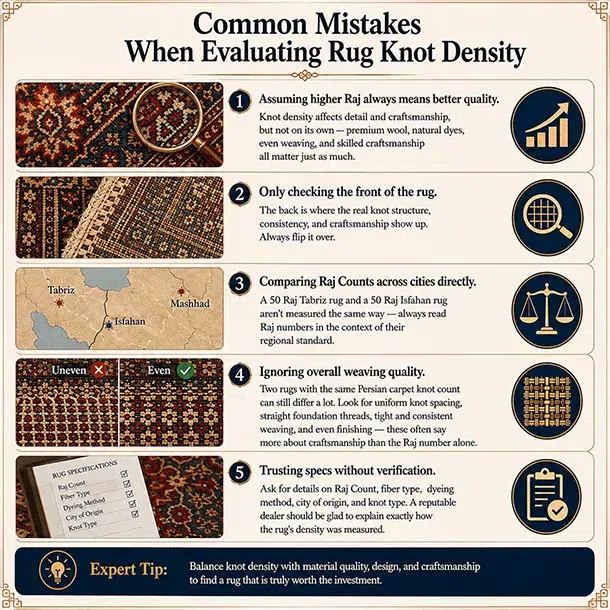
Knowing what rug knot density is only gets you so far. Here are the mistakes that trip up even careful buyers:
- Assuming higher Raj always means better quality. Knot density affects detail and craftsmanship, but not on its own — premium wool, natural dyes, even weaving, and skilled craftsmanship all matter just as much.
- Only checking the front of the rug. The back is where the real knot structure, consistency, and craftsmanship show up. Always flip it over.
- Comparing Raj Counts across cities directly. A 50 Raj Tabriz rug and a 50 Raj Isfahan rug aren’t measured the same way — always read Raj numbers in the context of their regional standard.
- Ignoring overall weaving quality. Two rugs with the same Persian carpet knot count can still differ a lot. Look for uniform knot spacing, straight foundation threads, tight and consistent weaving, and even finishing — these often say more about craftsmanship than the Raj number alone.
- Trusting specs without verification. Ask for details on Raj Count, fiber type, dyeing method, city of origin, and knot type. A reputable dealer should be glad to explain exactly how the rug’s density was measured.
Frequently Asked Questions About Rug Knot Density
Does a higher Raj Count always mean better quality?
Not necessarily. It signals a finer weave and more artistic detail, but not automatically better durability or overall quality. A well-made 35 Raj wool rug can hold up far better in a busy household than a delicate 70 Raj silk piece.
What’s the fastest way to check a rug’s Raj Count at home?
Flip the rug over, mark the standard measuring distance for its weaving region (7 cm for Tabriz-style, 6.5 cm for Isfahan/Kashan/Nain-style), and count the knots across that span. No special tools required, though a rug knot counter makes it faster on very fine weaves.
How much does knot density really affect the price?
A lot, but not by itself. Higher Raj Count means more labor and skill per square meter, which pushes price up — but material quality and artistic value carry just as much weight in the final number.
Is knot density the same thing as overall weave density?
Related, but not identical. Knot density (Raj Count) measures knots within a standard width. Overall weave density describes the compactness of the whole structure — knots, warp, and weft together.
What’s a 9 La Nain rug equivalent to in Raj?
Roughly 40–45 Raj. A 6 La Nain rug is much finer, comparable to 60 Raj or above.
Why can’t you compare Raj Counts across cities directly?
Because the measuring unit itself differs — Tabriz counts over 7 cm, Isfahan over about 6.5 cm. The same Raj number can represent a slightly different actual density depending on where it was measured.
Can you tell knot density from a photo?
Only roughly. A sharp close-up of the back of the rug next to a ruler can give you a ballpark estimate, but an accurate reading really needs an in-person inspection.
Does Raj Count apply to machine-made rugs?
No — Raj Count is specific to hand-knotted Persian rugs. Machine-made rugs are described using terms like face density, points, or pile density instead.
What Raj Count is best for everyday use?
For most homes, 40–45 Raj wool hits the best balance of durability, comfort, appearance, and value — ideal for living rooms and other high-use spaces.
Does knot density affect how long a rug lasts?
Not by itself. Lifespan depends more on fiber quality, dyeing method, weaving technique, and how well the rug is cared for. A well-made 40 Raj wool rug can often outlast a much finer silk rug in a high-traffic space.
Final Thoughts
Once you understand what rug knot density is, you can judge a Persian rug on more than looks alone. Between learning how to measure rug knot density, understanding what Raj Count actually tells you about craftsmanship, and recognizing how it affects value, you’re in a much better position to choose a rug that fits your needs and expectations.
Experienced rug experts never judge a carpet on Raj Count alone. Fiber quality, natural dyes, weaving consistency, design complexity, and regional craftsmanship all factor into what makes a hand-knotted rug genuinely valuable.
If you’re planning to purchase an authentic Persian carpet, take a look at our Complete Guide to Buying an Authentic Handmade Persian Rug for a full breakdown of materials, weaving techniques, regional styles, and other essentials before you invest.
On our online store, every Persian rug comes with detailed specifications — Raj Count, weaving origin, fiber type, and construction details — so you can shop with confidence and choose a rug worth passing down for generations.